
Monthly Financial Reports Every Business Owner Should Review
Most business owners know their bank balance. Far fewer know their gross margin, their receivables aging, or whether last month was actually profitable. That difference determines whether they understand the financial workings of their business.
According to a 2026 Small Business Financial Literacy Report by Eagle Rock CFO, only 42% of small business owners feel confident reading their own financial statements. And only 38% say they understand their cash flow statement at all. Yet the owners who do review these reports consistently tend to grow revenue roughly twice as fast as those who don't.
The reports themselves are not complicated. What matters is knowing which ones to pull, what to look for in each one, and what questions to ask when something looks off. Here’s a straightforward look at the five reports worth reviewing each month.
Quick Answer
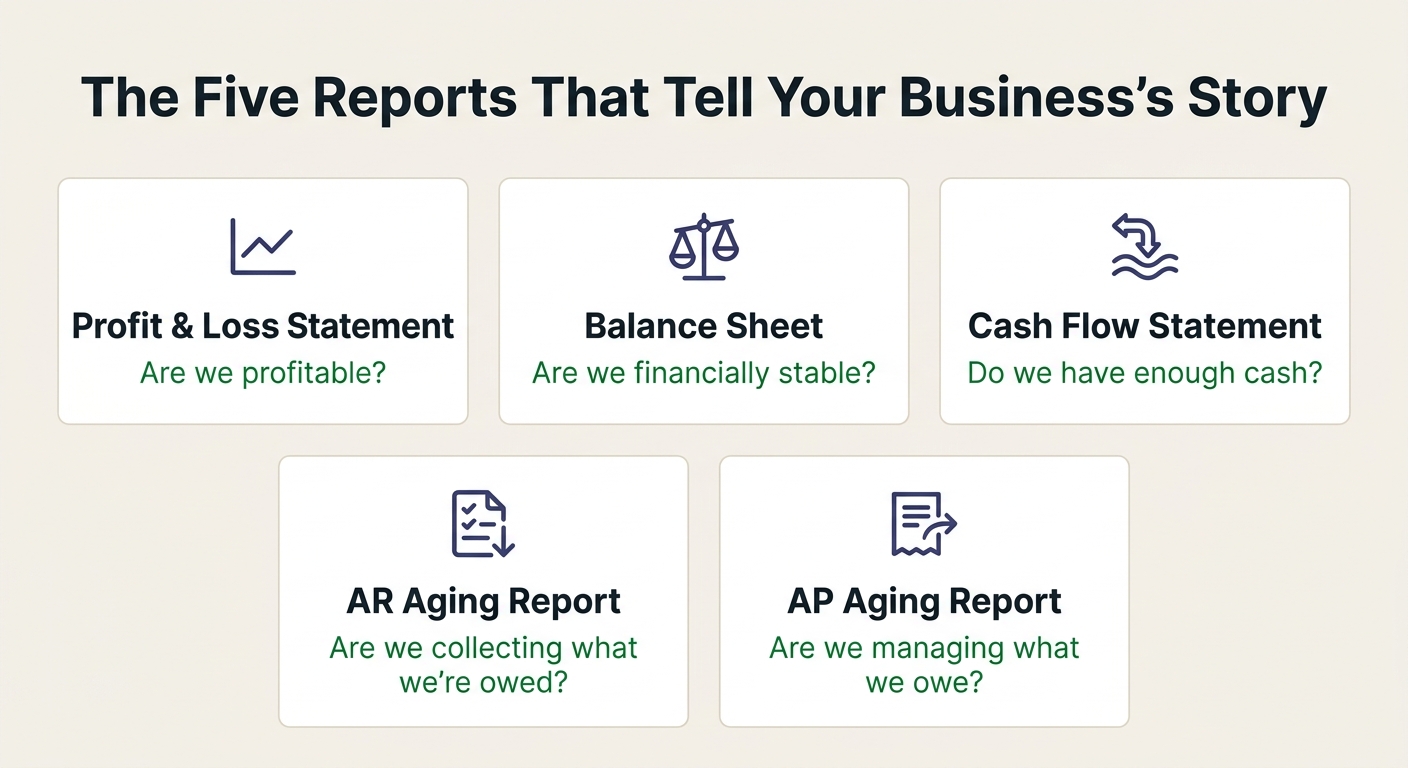
The five monthly financial reports every business owner should review are the Profit and Loss Statement, the Balance Sheet, the Cash Flow Statement, the Accounts Payable Aging Report, and the Accounts Receivable Aging Report. Together, they tell you whether your business is profitable, financially stable, managing what it owes, collecting what it is owed, and staying on top of cash.
What Your Profit and Loss Statement Is Telling You
The Profit and Loss Statement (also called the P&L or Income Statement) is the most commonly reviewed financial report, and for good reason. It shows you every dollar that came in and every dollar that went out during the month, and whether you ended up in the black or the red.
A well-kept P&L breaks down into three layers:
- Revenue: What you earned from sales or services.
- Cost of Goods Sold (COGS): The direct costs tied to delivering your product or service.
- Operating Expenses: Everything else- rent, software, payroll, marketing.
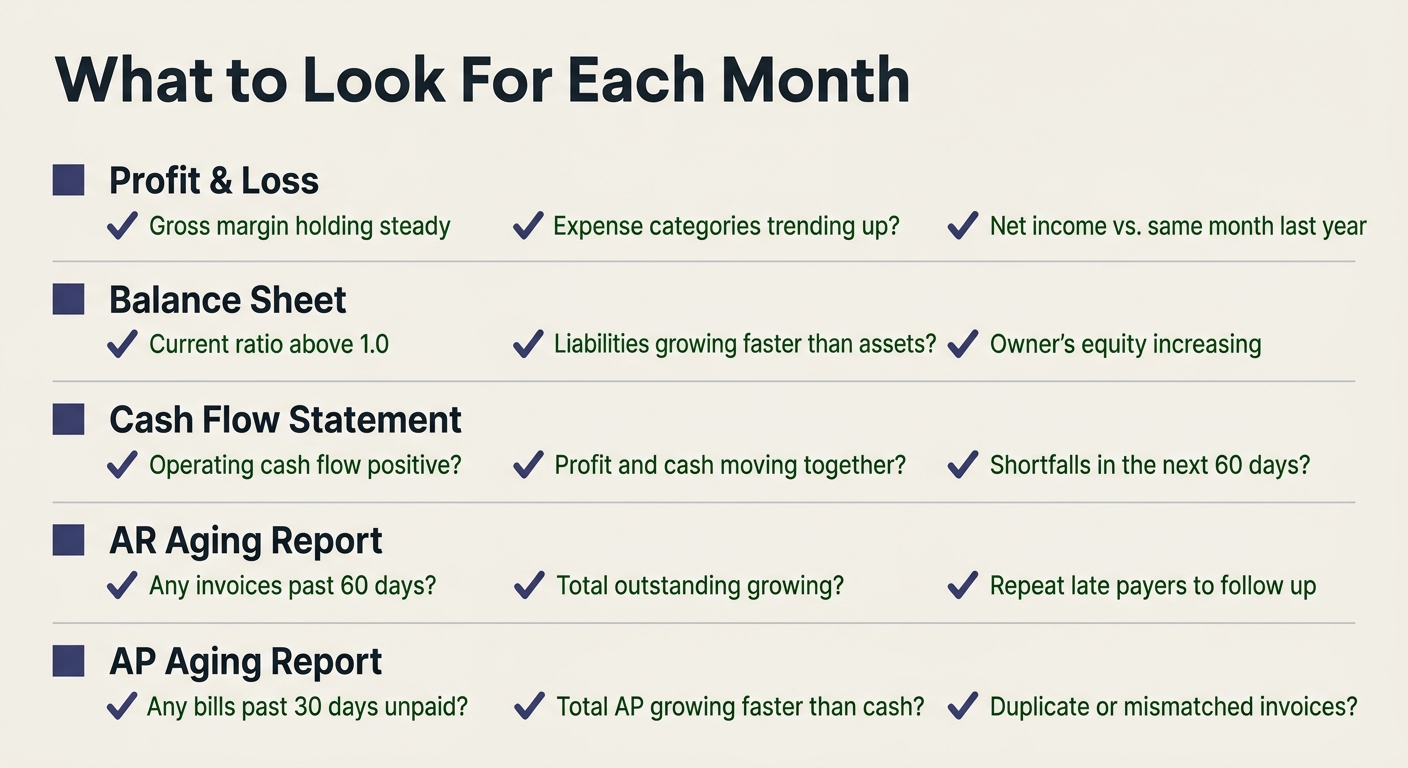
What to look for each month: Is your gross margin holding steady? Are any expense categories creeping up without a corresponding increase in revenue? Is this month's net income trending in the right direction compared to the same month last year?
A P&L built on clean, reconciled books gives you a clear picture. One built on unreconciled accounts is unreliable and perhaps misleading.
What Your Balance Sheet Reveals About Financial Health
The Balance Sheet is a snapshot of where your business stands financially on a single day, typically the last day of the month. It shows what you own (assets), what you owe (liabilities), and what's left over (equity).
Unlike the P&L, which covers a period of time, the Balance Sheet answers one specific question: *Is this business financially sound right now?*
Three things to check monthly:
- Current ratio: Do you have enough liquid assets to cover short-term obligations? A ratio above 1.0 means yes.
- Debt load: Are liabilities growing faster than assets? That's worth paying attention to.
- Owner's equity: Is it increasing over time? Steady growth here reflects a business building real value.
Many business owners skip the Balance Sheet because it feels abstract. In practice, it's one of the clearest indicators of whether a business is building toward something or slowly eroding.
Why the Cash Flow Statement Is the One Owners Miss Most
A business can be profitable on paper and still run out of cash. This is one of the most common and most preventable financial surprises a business owner can face.
The Cash Flow Statement explains exactly why. It tracks the actual movement of cash in and out of your business, organized into three activities: operating (your core business), investing (equipment, assets), and financing (loans, owner contributions).
The P&L records revenue when it's earned. The Cash Flow Statement records money when it actually arrives in your account. These two numbers are often different, especially if you invoice clients on net terms.
What to look for: Is operating cash flow consistently positive? Are you funding operations with financing activities, which is a short-term solution that doesn't hold long term? If your P&L shows profit but your cash flow is negative, your receivables process likely needs attention.
This is also the report most useful for planning ahead. Businesses that review cash flow monthly can detect potential shortfalls two to three months before they happen, according to recent financial advisory research.
How the Accounts Receivable Aging Report Protects Your Cash
If your business invoices clients, the Accounts Receivable Aging Report belongs in your monthly review. This report lists every outstanding invoice, organized by how long it has been unpaid: current, 30 days, 60 days, 90 days or more.
Unpaid invoices represent real money your business has earned but not yet collected. The longer they age, the harder they become to collect.
What to watch for each month:
- Are any invoices crossing the 60-day mark without communication?
- Is the total outstanding amount growing faster than your revenue?
- Are the same clients consistently late?
A clean AR Aging Report tells you that your collections process is working. A report full of 90-plus-day balances tells you the opposite. Reviewing the AR Aging report catches aging invoices before they become write-offs.
What Your Accounts Payable Aging Report Reflects
The Accounts Payable Aging Report is the counterpart to your AR Aging Report. Where AR tracks what clients owe you, AP tracks what you owe to vendors, suppliers, and service providers, organized by how long each bill has been outstanding: current, 30 days, 60 days, 90 days or more.
Reviewing AP monthly keeps your cash obligations visible and your vendor relationships intact. A bill that quietly ages past 60 days can trigger late fees, strained relationships with suppliers, or disruptions to services your business depends on.
What to look for each month:
- Are any payables approaching or past 30 days without a payment plan in place?
- Is total AP growing faster than your revenue or cash position can support?
- Are there duplicate invoices or bills that don't match what was agreed?
A clean AP Aging Report gives you a full picture of your near-term cash obligations. Combined with your Cash Flow Statement, it tells you not just how much cash you have, but how much of it is already spoken for.
How to Make Monthly Reviews a Practical Habit
Pulling these four reports doesn't require hours. With a well-maintained set of books, a monthly financial review can take 30 to 45 minutes. The key word is "well-maintained."
When books are behind, unreconciled, or mixed with personal transactions, none of these reports can be trusted. You're not reviewing your financials at that point- you're reviewing an estimate.
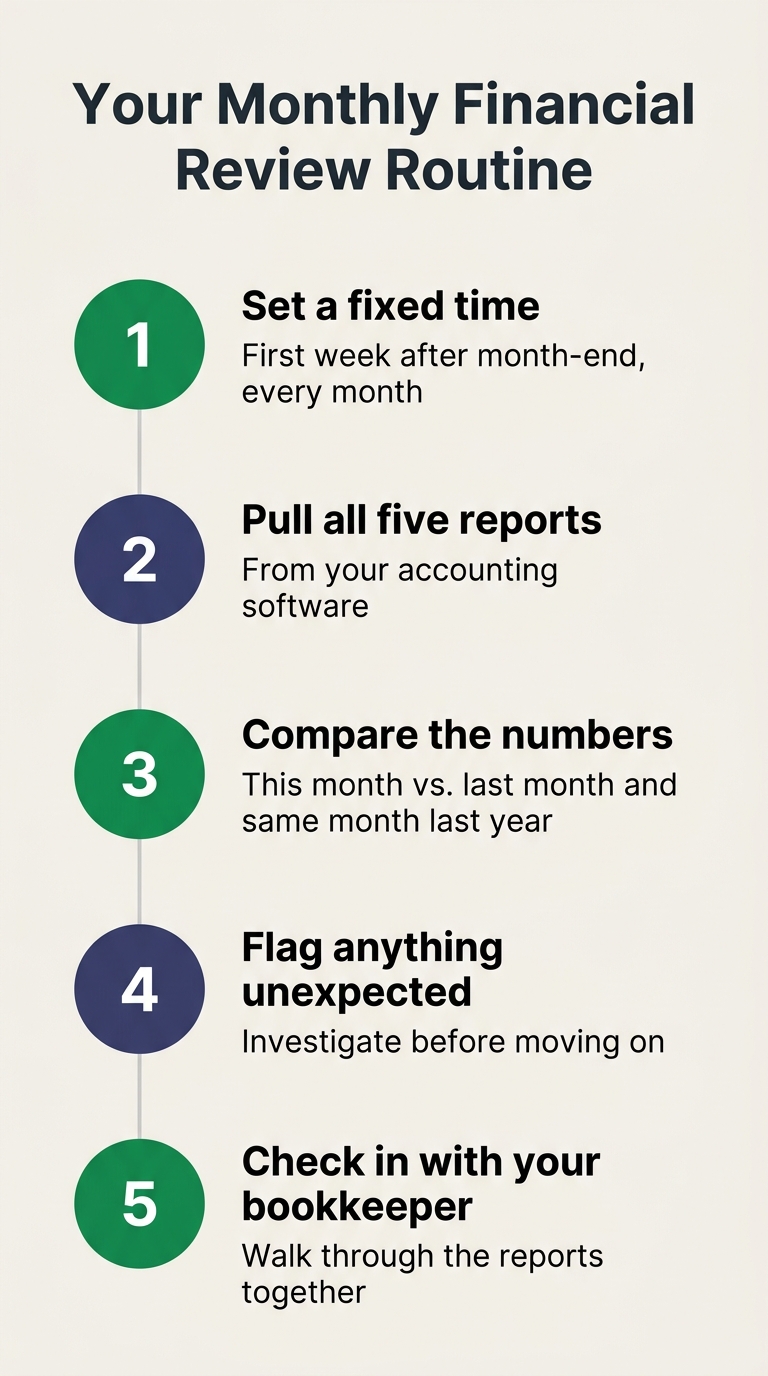
A straightforward approach:
1. Set a fixed time each month, within the first week after month-end.
2. Pull all five reports from your accounting software.
3. Compare this month to last month and to the same month last year.
4. Flag anything that looks unexpected and investigate before moving on.
If you work with a bookkeeper, this is also the right time for a brief check-in. A good bookkeeping relationship includes walking through these reports together, not just delivering them.
Over time, this habit builds the kind of financial awareness that improves decisions: what to price, when to hire, whether to take on a new line of credit, and when to hold steady.
Key Takeaways
- The five reports worth reviewing every month: Profit and Loss, Balance Sheet, Cash Flow Statement, Accounts Payable Aging, and Accounts Receivable Aging.
- Each report answers a different question. Together they give you a complete view of your financial position.
- Only 42% of small business owners feel confident reading their own financial statements (Eagle Rock CFO, 2026).
- Businesses that review financial reports consistently tend to grow revenue significantly faster than those that don't.
- Clean, reconciled books are what make these reports accurate and trustworthy.
Frequently Asked Questions
How long does a monthly financial review take?
With organized, up-to-date books, most business owners can complete a meaningful review in 30 to 45 minutes. The time investment compounds: the more familiar you become with your numbers, the faster and sharper the review gets.
Do I need an accountant to review these reports?
Not necessarily. A good bookkeeper keeps your records current and can prepare these reports each month. Your CPA or accountant typically steps in for tax planning, year-end review, and strategic guidance. The roles are different and both are useful.
What accounting software generates these reports?
QuickBooks, Xero, and most other cloud accounting platforms generate all four of these reports, provided the underlying bookkeeping is kept current.
What if my numbers don't make sense?
That's a signal worth taking seriously. Unusual numbers in a well-kept set of books usually point to a transaction that needs investigation. Unusual numbers in a set of books that hasn't been touched in months usually point to something else entirely.
About Tend Bookkeeping
Tend Bookkeeping provides professional bookkeeping, payroll, and financial reporting services for small and growing businesses. Emily and her team keep your records clean, consistent, and current so the reports you review each month are ones you can actually trust. As part of every engagement, Tend includes a monthly review conversation to walk clients through their reports and answer questions.